





A content management strategy is the set of standards, governance, and workflows an organization uses to keep content consistent, findable, and ready for reuse, including by AI systems.
As enterprise organizations race toward AI implementation, directors face a critical choice: wait to see what AI brings or take proactive steps to prepare their teams and platform. The smart move is preparation—specifically, strengthening your content management processes now.
Organizations with content scattered across systems, managed inconsistently, or trapped in departmental silos face mounting operational costs and risk jeopardizing their AI initiatives.
What is the hidden cost of disorganized content?
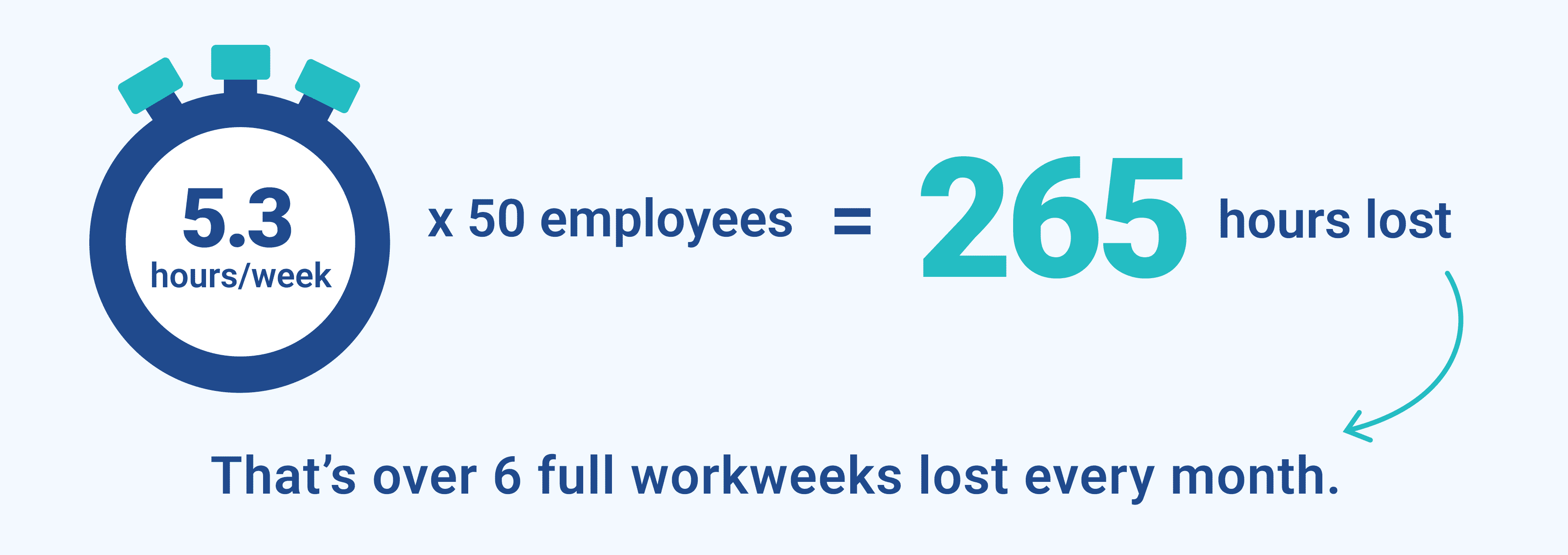
The hidden cost of disorganized content is lost time: American knowledge workers lose an average of 5.3 hours per week waiting for information or recreating content that already exists.
Most organizations and companies are sitting on a goldmine of institutional knowledge—years of documented expertise, processes, and customer interactions. Yet this valuable resource is often fragmented across departments, stored in inconsistent formats, or buried in outdated content management systems.
The result? Project delays, bottlenecked workflow, missed opportunities, employee frustration, and a hit to the bottom line.
Think about your company. How often have teams needed to recreate training materials they couldn’t locate? How frequently do customer-facing teams provide conflicting information from multiple versions of the same content on different platforms? These are common challenges in enterprise environments.
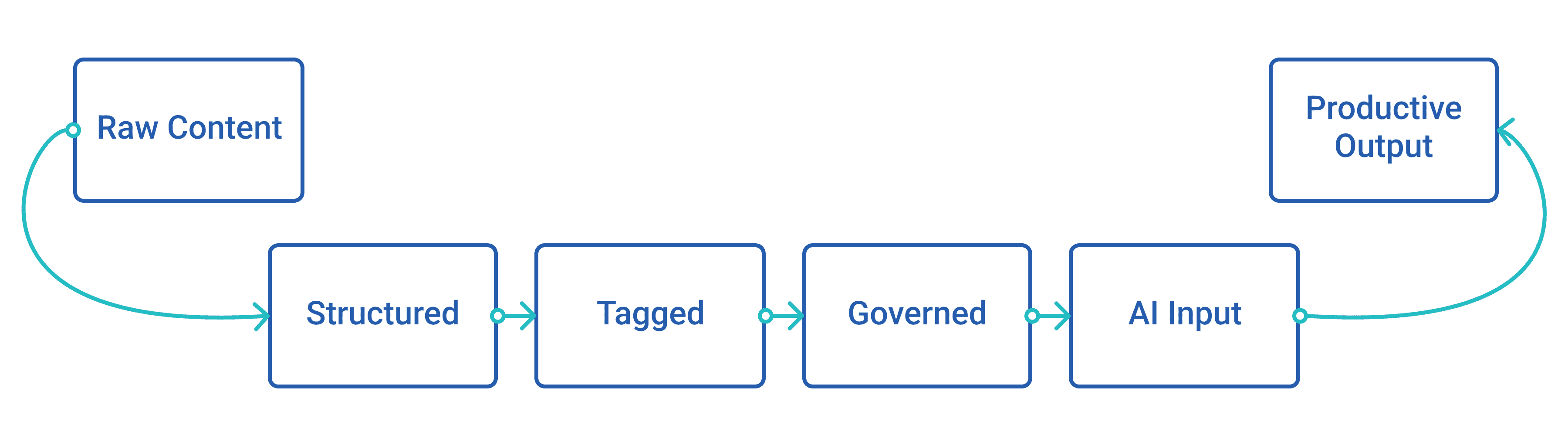
Disorganized content not only causes inefficiency, but also derails AI initiatives. Poorly structured or untagged content requires extensive cleanup before it can be used to train AI models, which delays deployment and lowers the quality of the results.
How do you set content goals and define your audience?
Start by defining what success looks like for your organization, then identify who you are creating content for. Your goals and audience together shape how you structure, store, and publish content.
Before overhauling your content management approach, step back and define success for your organization. Are you aiming to streamline internal workflows, reduce project delays, enhance website consistency, or better support AI readiness? Each goal will shape how you structure your content, choose platforms, and measure performance.
Equally important is understanding who you're creating content for. Whether your primary audience is customers, internal teams, or compliance stakeholders, their needs should inform your content workflow and publishing strategy. A customer-facing knowledge base requires different CMS features and governance than internal training documentation.
By aligning your content goals with audience needs, you ensure your content management process delivers value across the organization. This clarity also fosters stronger cross-team collaboration, reduces workflow friction, and enables your teams to create content with purpose, rather than simply filling space.
How do you build future-ready content foundations?
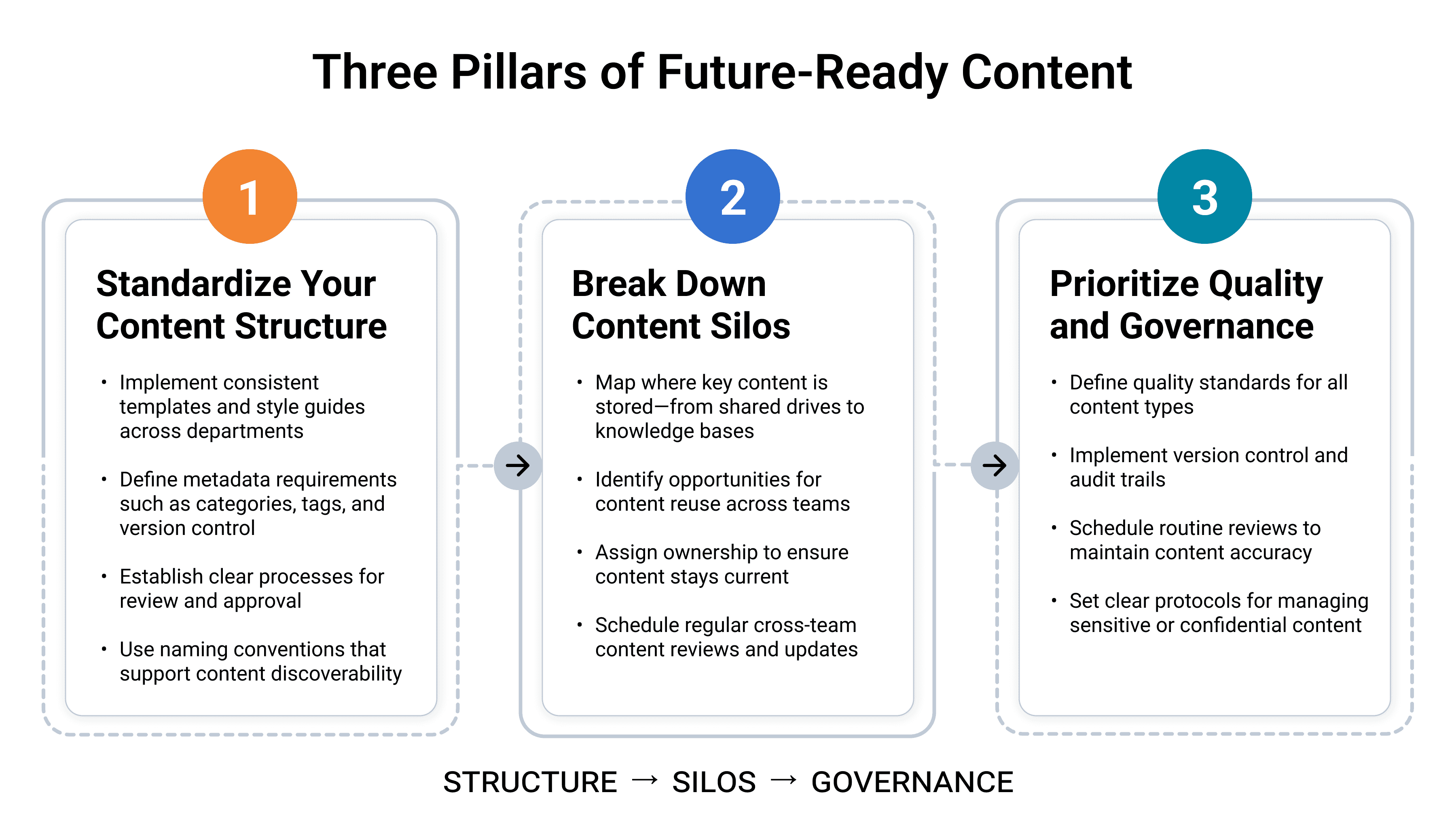
You build future-ready foundations with a three-pillar framework: standardize your content structure, break down content silos, and prioritize quality and governance.
To prepare for AI, leaders must first address the foundation: how content is created, managed, and shared. Modernizing your content practices not only solves current operational challenges, but also lays the groundwork for long-term success with AI.
Areas of Operational Focus:
Pillar 1: Standardize your content structure
Standardization means applying consistent templates, metadata, and naming conventions across teams. It is the foundation of structured content and reliable structured authoring.
Implement consistent templates and style guides across departments
- Define metadata requirements, such as categories, tags, and version control
- Establish clear processes for review and approval
- Use naming conventions that support content discovery
Pillar 2: Break down content silos
Content silos are pockets of content trapped within departments, drives, or systems that other teams cannot easily find or reuse. See how to start breaking down content silos.
- Map where key content is stored—from shared drives to knowledge bases
- Identify opportunities for content reuse across teams
- Assign management responsibilities to ensure content stays current
- Schedule regular cross-team content reviews and updates
Pillar 3: Prioritize quality and governance
Content governance is the system of standards, roles, and review processes that keep content accurate, consistent, and compliant over time. For sensitive material, apply strong content management security practices.
- Define quality standards for all content types
- Implement version control and audit trails
- Schedule routine reviews to maintain content accuracy
- Set clear protocols for managing sensitive or confidential content
See how structured content scales in IXIA CCMS
What are the benefits of stronger content management?
Stronger content management saves time, improves consistency, reduces compliance risk, and speeds onboarding, while preparing your content to power AI tools.
These improvements offer tangible advantages across your organization. By reducing the time employees spend searching for or recreating content, you’ll immediately boost productivity. Standardized content ensures more consistent customer communications, enhancing the overall customer experience.
Cross-functional teams benefit from smoother collaboration, while clear audit trails and up-to-date documentation reduce compliance risk and simplify internal reviews. These workflow changes also accelerate onboarding by providing new team members with fast access to accurate, reusable materials, all of which contribute to a more efficient and resilient operation.
Smart content infrastructure also enhances compliance. With clear audit trails, version control, and role-based permissions, organizations can respond confidently to regulatory reviews or internal audits. As teams grow or shift, well-governed content accelerates onboarding—new employees gain immediate access to accurate, reusable resources that reflect the most up-to-date standards.
Most importantly, intelligent content management lays the foundation for scalable innovation. Structured, tagged content enables AI tools to deliver real-time search, automate translation, and even support predictive insights across your documentation ecosystem. What was once static content becomes an active operational asset, ready to evolve alongside your business needs.
By shifting from reactive content practices to a proactive, technology-enabled approach, organizations not only reduce risk, but also gain a strategic edge.
How do you put a content strategy into practice?
Put a content strategy into practice in four steps: audit your content, standardize one team first, document the process, then measure and share results.
- Conduct a content audit, a structured review of your content to find duplication, outdated files, and hard-to-find materials. Identify pain points, such as duplication, outdated files, or materials that are difficult to find.
- Start small – Standardize templates in one department to build momentum for enterprise-wide change.
- Document your process – These materials support onboarding and maintain consistency.
- Measure improvements and share results – Track metrics such as time saved, reduced duplication, and improved customer experience.
Which MadCap tools support content management?
MadCap offers an integrated stack for content management: Flare for authoring, Flare Online for cloud collaboration, IXIA CCMS for component content management, and SyndicateAI for delivery and analytics.
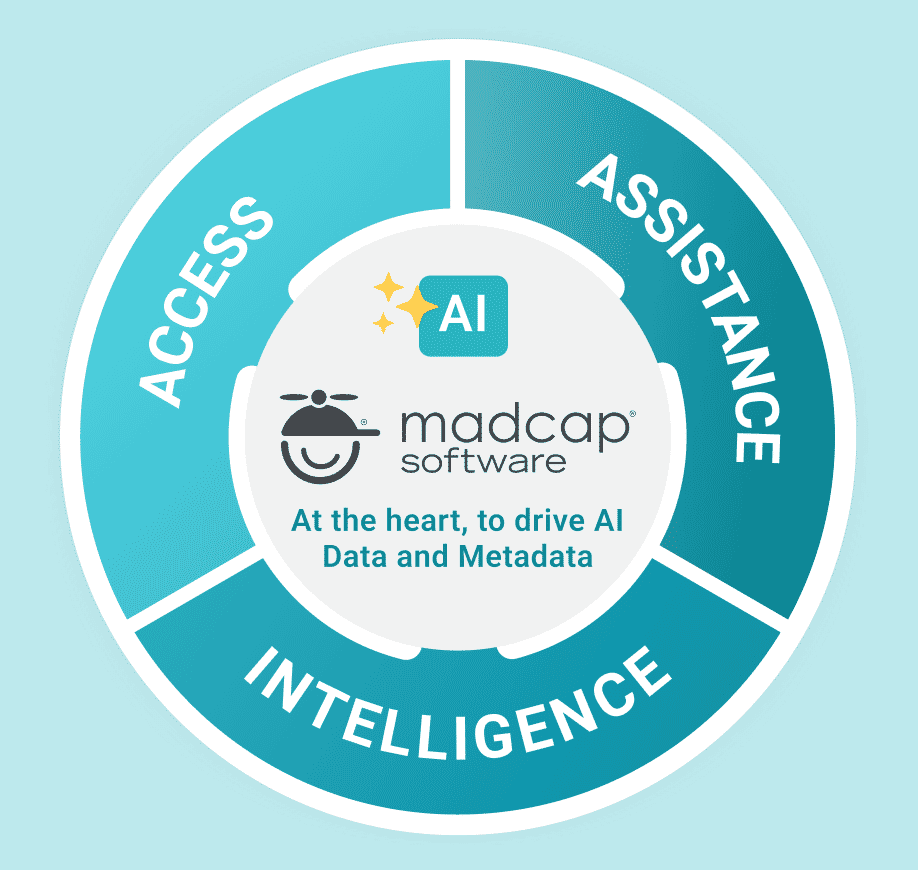
Strengthening content management doesn’t have to be overwhelming. MadCap Software solutions offer an integrated infrastructure to transform fragmented content into a strategic asset. These tools deliver immediate value through streamlined workflows and content reuse, while building a foundation for future AI readiness.
MadCap Flare is industry-leading technical writing software trusted for authoring complex technical documentation, knowledge bases, and online help. With single-source publishing, robust authoring tools, and total control over outputs, Flare transforms how you create and maintain content at scale.
Flare Online brings the full power of Flare into a cloud environment—making it the ideal cloud-based workflow management software. Real-time collaboration, secure versioning, and anywhere access enable distributed teams to work smarter and faster, all within an integrated web interface.
IXIA CCMS streamlines the creation and management of complex technical documentation. Its structured authoring capabilities allow teams to easily create modular content that can be reused across multiple outputs, reducing costs and increasing efficiency.
Unified Content Delivery & Analytics
Take your content strategy even further with MadCap SyndicateAI, a powerful content delivery and analytics platform. MadCap SyndicateAI centralizes your published content, offers secure delivery options, and provides actionable analytics—helping you measure engagement, optimize resources, and future-proof your content operations.
Want to try Madcap Software solutions? Take advantage of the free trials:
Frequently Asked Questions
What is a content management strategy?
A content management strategy is the set of standards, governance, and workflows that keep content consistent, findable, and reusable across an organization. It defines how content is created, stored, reviewed, and retired, so teams stop recreating work and content stays ready for new uses, including AI.
How do you future-proof content for AI?
You future-proof content for AI by standardizing structure, breaking down silos, and governing quality before AI is deployed. Structured, tagged, well-maintained content can train and feed AI tools without expensive cleanup. Disorganized content delays AI projects and lowers output quality.
Why does content need to be structured before using AI?
AI systems produce better results from structured, tagged content because they can parse it reliably. Poorly structured or untagged content requires extensive cleanup before it can train models, which delays deployment and weakens accuracy. Standardizing structure first protects both speed and quality.
What are content silos and why are they a problem?
Content silos are pockets of content trapped within departments, drives, or systems that other teams cannot easily find or reuse. They cause duplicated work, conflicting versions, and lost institutional knowledge. Knowledge workers lose an average of 5.3 hours per week searching for or recreating content.
What is content governance?
Content governance is the system of standards, roles, and review processes that keep content accurate, consistent, and compliant over time. It includes quality standards, version control, audit trails, and clear ownership. Strong governance reduces compliance risk and makes audits and onboarding faster.
How do you start improving content management?
Start with a content audit to find duplication, outdated files, and hard-to-locate materials. Then standardize templates in one department to build momentum, document the process, and measure results such as time saved and reduced duplication. Small, measured wins drive enterprise-wide change.