





Most enterprises do not have a content creation problem. They have a delivery control problem.
Documentation lives in a CCMS. Training lives in an LMS. Support articles live in a CRM. Portals, applications, chatbots, and AI assistants each pull from fragmented copies of the same information. Every system claims to be the source of truth, but what governs how knowledge flows between them?
That model was inefficient when publishing was manual. In an AI-driven enterprise, it becomes a structural liability.
Content is no longer static output. It is operational infrastructure. Organizations that cannot control how knowledge moves across systems cannot control what fuels their customer experiences, employee enablement, or AI-powered services.
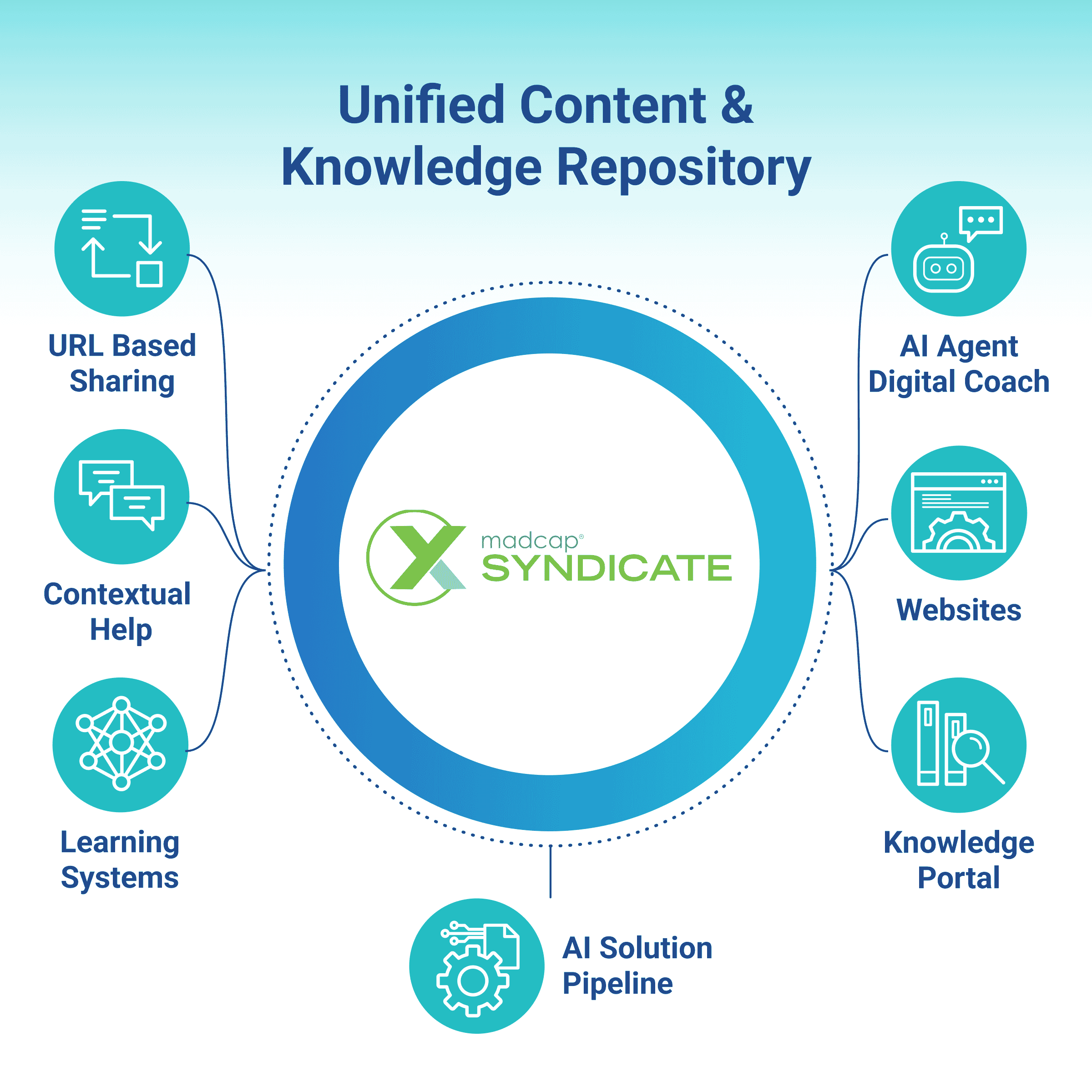
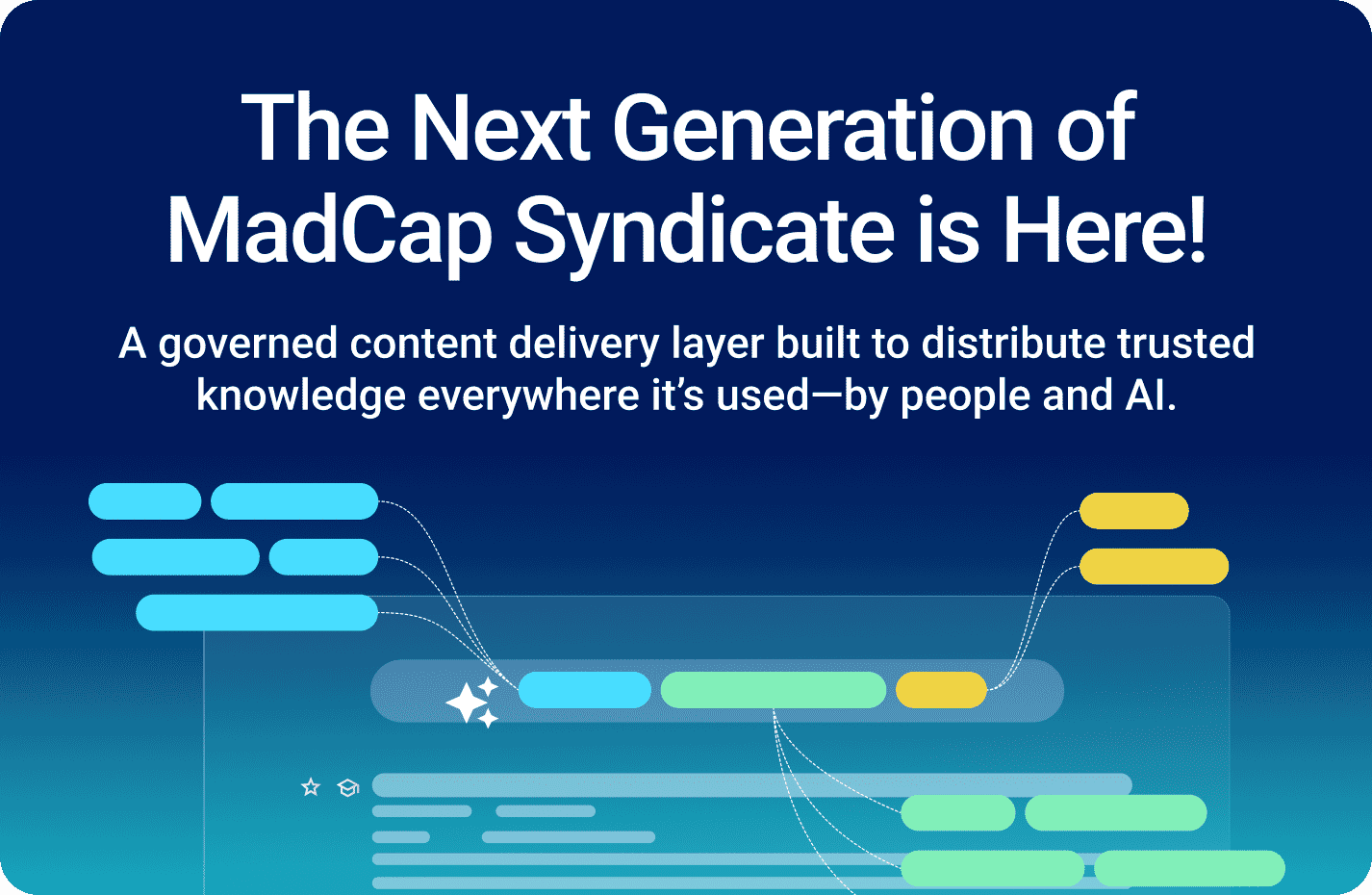
MadCap Syndicate addresses this gap. As a Unified Content Fabric, it operates as a governed delivery layer that connects content systems across the enterprise and controls how trusted knowledge flows outward to every endpoint. It does not replace authoring tools or learning platforms. It governs how they distribute.
AI Changes the Stakes
Large language models retrieve whatever content is accessible to them. They do not evaluate whether that content is current, authorized, or consistent. When information is duplicated, outdated, or fragmented across systems, AI assistants confidently return incorrect answers. What was once a workflow inconvenience is now a business risk.
This is where Syndicate functions as an AI Governance Engine. At the delivery layer, it ensures that only current, authorized, and compliant content is exposed to downstream systems, including portals, LMS platforms, CRMs, embedded help environments, and AI assistants. Unauthorized versions cannot drift into production. Expired content is revoked globally. Permissions are enforced across every connected endpoint.
Without a governed distribution layer, version drift becomes invisible, compliance becomes reactive, and AI outputs become unpredictable. Organizations may structure content carefully inside authoring systems, but if distribution is uncontrolled, the knowledge foundation remains unstable. AI does not create this weakness. It reveals it.
A New Operating Model
Syndicate changes how enterprise content flows.
Rather than exporting files into downstream systems where copies accumulate and diverge, organizations govern content once within Syndicate and distribute it everywhere its needed.
When updates are made, Syndicate automatically propagates them across all connected destinations. When permissions change, they take effect system-wide. When content reaches its expiration date, Syndicate removes it from every endpoint simultaneously. Version history remains traceable and auditable throughout.
The result is a master control layer for knowledge flow, one that eliminates the operational overhead of manual publishing and replaces it with continuous, metadata-driven distribution. Publishing decisions are no longer repeated downstream. They are made once and enforced everywhere.
The Enterprise Impact
For technical documentation teams: Syndicate transforms structured content into scalable infrastructure. Instead of maintaining fragmented portals and static exports, teams distribute governed content across every delivery surface from a single source. Documentation becomes a controlled, enterprise-wide asset capable of supporting AI retrieval and semantic search.
For learning and development teams: Syndicate provides both scale and audit defensibility. Learning content integrates with LMS platforms through governed distribution, rather than duplication. Syndicate tracks lifecycle state, enforces expiration, and maintains delivery records, enabling organizations to demonstrate what was delivered, when, and to whom.
For support teams: Syndicate ensures that agents, self-service portals, and AI assistants all retrieve from the same authorized source. There is no ambiguity about which version is current, which reduces resolution time and improves answer accuracy across every channel.
For senior leadership: Syndicate establishes a compliance layer for enterprise AI. By operating at the distribution layer, it prevents outdated, unauthorized, or noncompliant content from fueling automated systems, supporting audit readiness, regulatory protection, and long-term AI maturity.
The Risk of Operating Without It
Organizations scaling without a governed delivery layer encounter predictable friction. Mergers introduce silos that never reconcile. Global updates roll out unevenly. AI initiatives stall because content lacks consistent structure and metadata. Regulatory exposure grows quietly as version control erodes. Analytics remain fragmented, obscuring how knowledge actually performs across the enterprise.
Without Syndicate, each system operates in isolation. With it, every system participates in a connected, governed ecosystem. Enterprises eventually reach a delivery control ceiling. Syndicate removes that constraint.
From Fragmented Systems to a Unified Content Fabric
Governed distribution is not simply about speed. It is about enforced consistency, controlled AI enablement, cross-system visibility, and lifecycle management from a centralized infrastructure layer.
MadCap Syndicate is the connective architecture that transforms documentation, learning, and support content into a Unified Content Fabric, ensuring that human users and AI systems alike consume approved content from a single source of truth.
Organizations deploying AI without delivery governance are building on unstable foundations. Those that implement Syndicate establish a knowledge infrastructure capable of scaling with confidence.
The need is not more tools. It is a governed layer that controls how knowledge flows. Syndicate is that layer.
Ready to govern your knowledge infrastructure? See how MadCap Syndicate connects your content systems and puts you in control of every endpoint. Request a demo
Frequently Asked Questions
What is MadCap Syndicate and how is it different from a content management system?
MadCap Syndicate is not a content management system. It is a governed delivery layer that sits between your existing content systems and the endpoints that consume them. Where a CMS manages how content is created and stored, Syndicate governs how it is distributed, ensuring that every portal, platform, AI assistant, and integrated application receives the same authorized, current version of your knowledge at all times.
How does Syndicate support enterprise AI initiatives?
AI systems retrieve whatever content is accessible to them. If that content is outdated, duplicated, or inconsistently structured across systems, AI outputs will reflect those problems. Syndicate acts as an AI Governance Engine at the delivery layer, ensuring that only current, authorized, and compliant content is exposed to AI assistants and retrieval systems. This gives organizations a stable, trustworthy knowledge foundation for AI-powered experiences.
Which systems and platforms does Syndicate integrate with?
Syndicate is designed to integrate with the enterprise platforms your teams already use, including Salesforce, SAP, Zendesk, LMS platforms, customer portals, and embedded help environments. Content flows outward through APIs, meaning downstream systems receive governed knowledge directly, rather than working from copied or exported files.
How does Syndicate help with regulatory compliance and audit readiness?
Syndicate maintains a traceable version history across every connected endpoint. When content expires, it is removed from all systems simultaneously. When permissions change, they are enforced system-wide. This creates a clear, auditable record of what content was delivered, where it was delivered, and when, which is essential for organizations operating in regulated industries or managing compliance-sensitive knowledge.